Hedge to a plan, not a rate.
An FX policy that gives finance teams a clear, governed way to decide how much to hedge, and how far ahead.

An FX policy that gives finance teams a clear, governed way to decide how much to hedge, and how far ahead.
Most CFOs understand what currency volatility can do to a business’s margins, cash flow and budget. Most also know they should hedge to protect against it. The harder questions are how much to hedge, and how far ahead. A descending wedge answers both, with a policy simple enough to explain to a board in a few minutes.
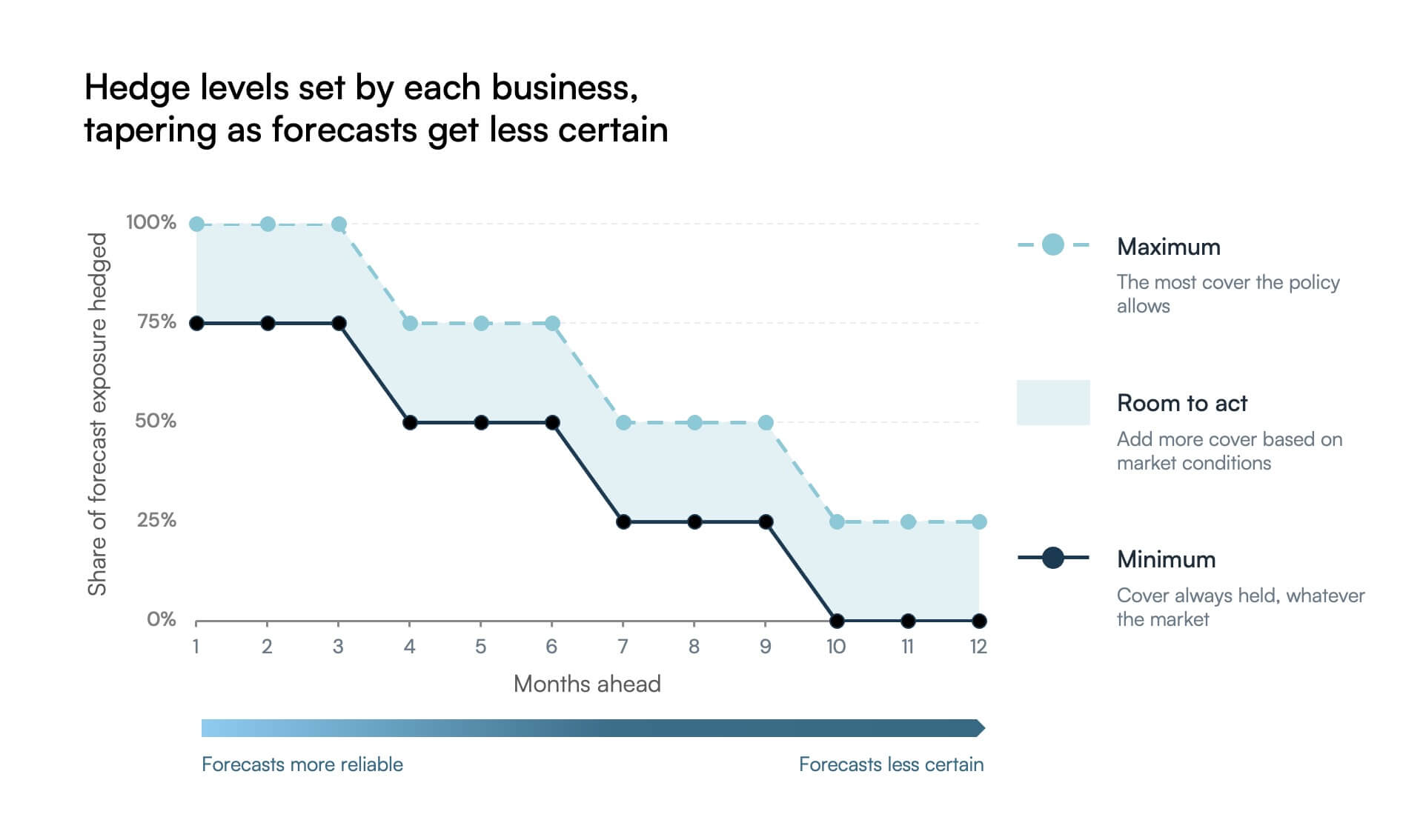
A descending wedge sets a minimum and maximum hedge level for each month ahead, typically over 12 months, though the horizon depends on the business. A policy could also use quarters rather than months.
Hedge levels are highest in the near term, where forecasts are most reliable, and taper off further out, where they are less certain. Plotted, the levels form a wedge that descends over time.
It is a rolling policy. Month 1 is always the current month. As time moves on, each exposure moves into a nearer month and its required hedging rises.
The minimum is the critical cover the business always holds. The maximum is the most it can hold. The gap between them is where the risk manager can act on market conditions.
A descending wedge works best where foreign currency flows are regular and can be forecast with reasonable confidence. Typical examples:
It also suits finance teams that need to show clearly why hedging decisions were made, in a way that is straightforward to manage and to explain to a board, auditors or investors.
It is less suited to one-off or irregular exposures, such as an acquisition, a large capital purchase or a single contract. Those are usually hedged individually against the specific deal.
Every FX policy starts with risk appetite: how far below budget the business is willing to let its foreign currency cash flows fall. In a descending wedge policy, the proposed hedge levels are stress tested against this limit using simulated FX volatility and adjusted until the modelled shortfalls stay within it.
For example, an Australian company expecting AUD 15m from its US dollar revenue might set a risk appetite of 5%, or AUD 750k. Unhedged, in 95% of modelled scenarios the shortfall stays under AUD 2m. With the right policy in place, that worst case loss falls to around AUD 730k, inside appetite.
That testing is done through scenario modelling, which runs the policy through a range of possible currency movements to show how it holds up. The results are a guide rather than a prediction. The aim is hedging levels that are approximately right rather than precisely wrong.
Without a policy, hedging decisions tend to follow the market rather than the business. Cover gets added when rates look good and held back when they don’t, in the hope of a better rate. That turns hedging into a bet on currency direction, which is the very risk hedging is meant to remove.
That approach exposes the business in three ways:
In practice, running the policy needs three things.
With those in place, the policy does what it was set up to do: keep currency risk within appetite, with every decision led by a clear rule.
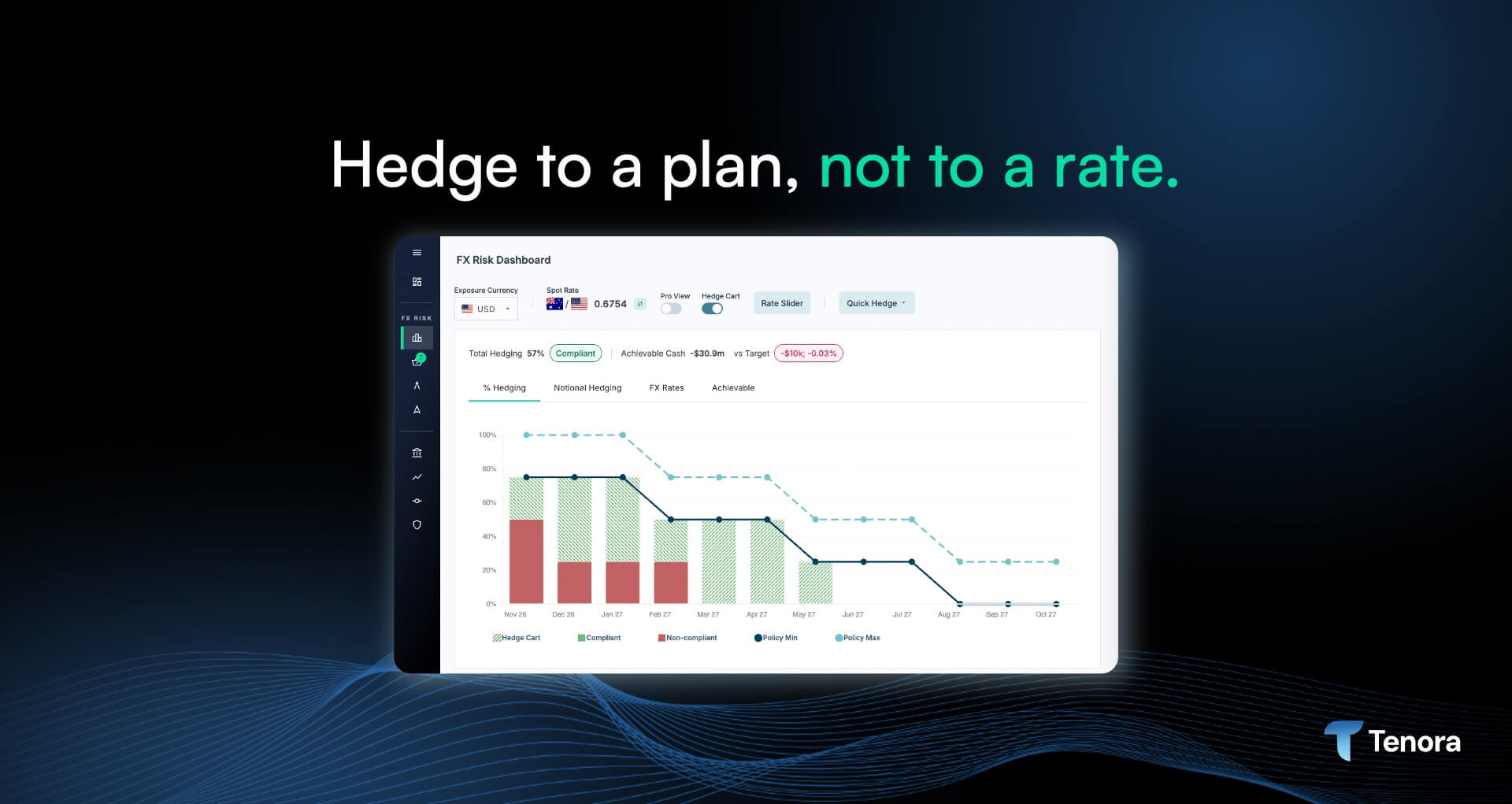
On the Tenora platform, your policy is built from live data. Your policy, exposures and hedge positions sit in one place, so cover against each level is visible at any time, by currency and by month (or quarter). A revised forecast or a new trade shows its effect on your exposures and policy compliance straight away, enabling you to manage it effectively.
Hedge levels can be tested against risk appetite using the platform’s scenario modelling before they are set, and revisited as the business changes.
When cover falls below a minimum level, you can request competitive quotes from your counterparties and execute trades to top it up, all on the same platform and in a matter of seconds.
And as everything is all in one place you have an audit record of every trade, every decision that was made and the policy they were made against.
To find out more, email connect@tenora.com.
Take the first step towards smarter, more transparent FX decisions.
Our blog