In the press: Fexco investment coverage roundup
A roundup of the coverage following Fexco's £7.5m commitment to Tenora.

The foreign exchange market is the largest in the world. According to the Bank for International Settlements, $9.6 trillion is traded every single day. Yet for most businesses, managing FX remains needlessly complex, costly, and opaque.
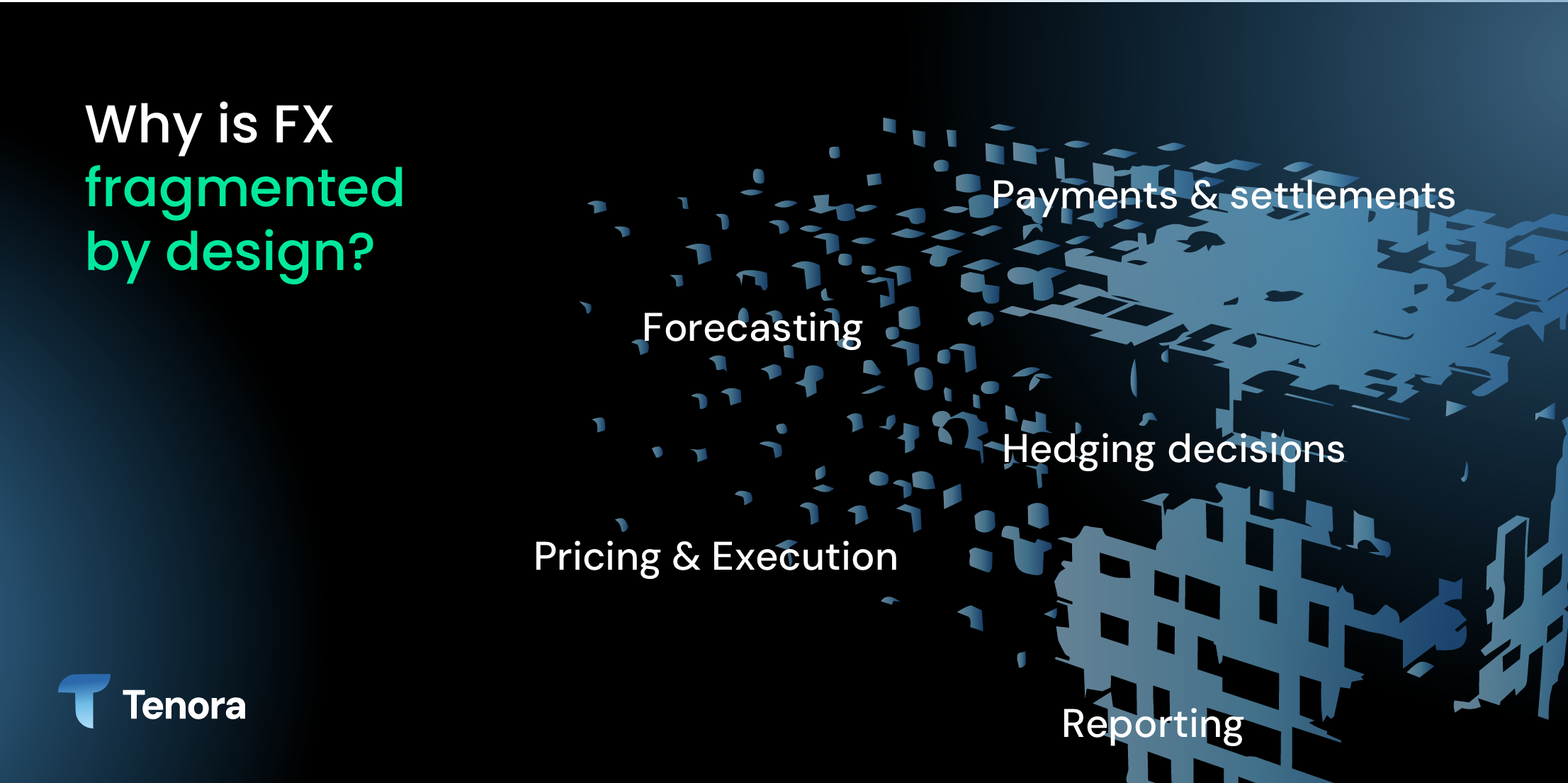
That is not a coincidence. Fragmentation is built into the FX market by design, sustained by the commercial incentives of the providers operating within it.
FX fragmentation is the management of foreign exchange as a series of disconnected activities rather than a single, connected process.
Forecasting sits with one team, execution with another, reporting with a third. Systems do not talk to each other. Providers focus on their own slice without visibility of the whole. This results in slow decisions based on stale data, opaque pricing, and an FX function that reacts to markets rather than managing them.
FX fragmentation persists because the market evolved around specialisation, and no participant is designed, or incentivised, to own the full process.
Banks, ERPs, TMS platforms, and advisors each bring capability to parts of the lifecycle, but none are designed to own the process end-to-end. Alignment across the full FX lifecycle is left to the business to solve.
In many cases, providers are not incentivised to change this. Greater transparency, faster decision-making, and streamlined workflows reduce demand for manual intervention, bespoke advisory, and opaque execution, directly threatening the margins of the services built around them.
Fragmentation endures in part because it benefits the system that produced it.
FX fragmentation costs organisations through slower decisions, higher execution costs, inconsistent hedging, and unexpected P&L volatility, often without finance teams realising the source.
The cost is cumulative and often invisible until it becomes material. It also makes FX risk difficult to communicate clearly to boards, investors, and lenders who increasingly expect structured, auditable processes.
Most damaging of all, fragmentation prevents organisations from consistently answering the three questions at the heart of effective FX risk management:
Without a connected process to answer these, FX risk management becomes reactive, responding to market movements after they occur rather than managing risk as conditions evolve.
FX Orchestration treats the entire lifecycle — exposure forecasting, risk monitoring, concluding hedging decisions, pricing and execution, settlement and payments, and reporting — as a single connected flow, where decisions made at one stage inform the next.
It does not require a wholesale transformation. It begins with visibility: understanding where fragmentation exists today and where it is slowing decisions and control. Some organisations that have made this shift have reported hedging costs reducing by over 70% and P&L volatility cut in half.
The starting point for any organisation is to map where fragmentation exists across their FX lifecycle and identify where disconnected systems, teams, or providers are creating the greatest cost or risk.
The FX market evolved around specialisation. The organisations winning now on FX are building around connection.
I've written about this in more depth, and offered simple steps to help organisations move towards FX Orchestration, in the full Tenora white paper: How FX Orchestration Will Redefine FX Risk Management.
Take the first step towards smarter, more transparent FX decisions.
Our blog