Can you answer these 5 questions about your last FX decision?
Take your most recent FX decision and see if you can answer these five questions.

Take your most recent FX decision and see if you can answer these five questions.
At some point, someone will ask about a decision you made months ago: why you hedged when you did, or why you didn't. It might be a board member or an auditor.
Without a clear, evidenced answer, even a good decision can still look like an unmanaged risk to whoever's assessing it.
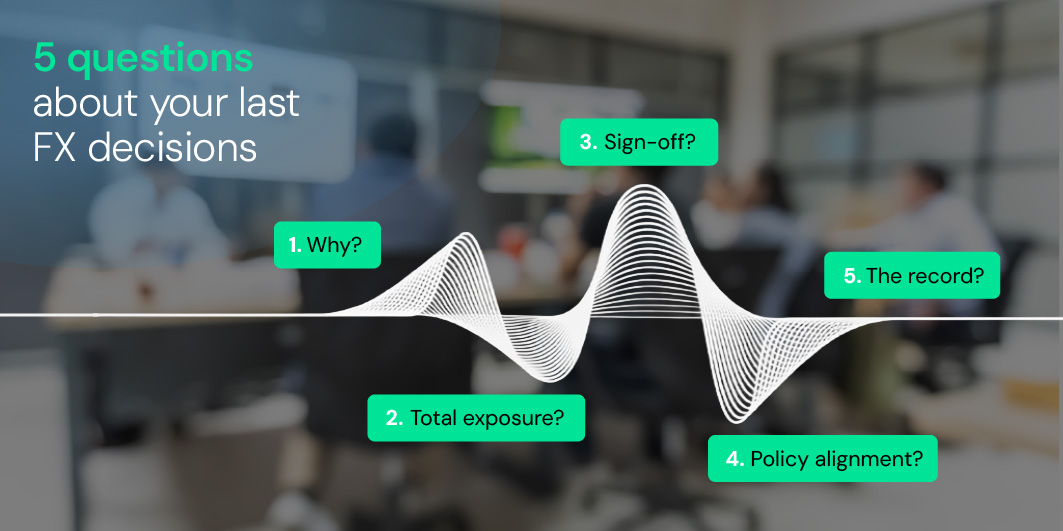
Here's a simple test. Take your most recent FX decision and see if you can answer these five questions.
This is a question about data, visibility, and understanding the business's exposure. What's important to note here is that a decision can have a good outcome and still be ungoverned. Governance isn't about the outcome but rather whether the reasoning would hold up if someone challenged it today.
A weak answer: "Our broker told us the rate was great that day."
A well-governed answer: "Our agreed policy sets out the minimum percentage of forecasts we must hedge to protect the business. Our automated processes flagged that we were outside those parameters, and we topped up to bring us back within policy."
You can't judge whether a decision was sound without knowing the full picture it was made against. If your exposure lives across multiple currencies, forecasts, intercompany flows, and supplier contracts, tracked in separate spreadsheets and updated at different times by different people, there's a good chance nobody had the complete number at the moment the decision was made.
A weak answer: "Roughly $X. We'd have to pull it together to be sure."
A well-governed answer: "Our total exposure across all currencies and entities was $X, and here's the breakdown by currency and business unit as of that date."
Boards and auditors want to know a decision was approved by the right person, at the right point in the process. If you can't evidence who approved a decision and when, you don't have accountability.
A weak answer: "It came up in a meeting, I don't remember exactly when."
A well-governed answer: "[Name] signed off on [date], ahead of execution, in line with our approval threshold for decisions of this size. Here is the audit trail."
Most businesses have a policy document somewhere. A policy that only gets checked once a year, or only when someone asks, isn't live control. If checking alignment means going and finding the policy first, that's a sign the policy isn't actually governing day-to-day decisions.
A weak answer: "I'd need to go back and check the policy."
A well-governed answer: "This decision ensures we remain within the risk parameters set out in our FX policy."
A verbal explanation of good judgement isn't an audit trail. If the record of a decision is scattered across emails or meeting notes, it's easily lost and hard to collate.
A weak answer: pointing at an inbox and saying "it's in there somewhere."
A well-governed answer: pulling up a single record of all time-stamped transactions.
Getting to a place where you can answer all five, consistently and without digging, isn't about working harder or keeping better notes. It's about having live visibility into your exposure and decisions as they happen. Not long ago, that kind of real-time view simply wasn't realistic for most finance teams without a dedicated treasury specialist.
That's changed. The technology now exists to give mid-sized importers and exporters the same live oversight that used to require a full treasury function, so every decision is well governed from the moment it's made. Beyond making these five questions easy to answer, it saves the time spent chasing down records after the fact, and the cost of the gaps that go unnoticed until an audit or a board meeting brings them to light.
Take the first step towards smarter, more transparent FX decisions.
Our blog